
The headlines are loud. The opinions are louder. Here's a practical breakdown for New Zealand Schools.
If you've been keeping half an eye on education news lately, you've seen the coverage. The government is making significant changes to New Zealand's curriculum and qualification system — and depending on who you ask, it's either long overdue or concerning.
The truth, as usual, sits somewhere in the middle.
This article isn't here to take sides. It's here to give you a clear picture of what's changing, when, and what that's likely to mean for you in the classroom.
What's Actually Changing for the New Zealand Curriculum
The government has confirmed a staged overhaul of New Zealand's curriculum and qualifications framework. The key changes include:
NCEA Level 1 will be removed. Year 11 students will instead complete a Foundational Skills Award — focused on literacy and numeracy.
New subject-based qualifications will replace the current Level 2 and Level 3 framework.
A more structured curriculum and grading system will be introduced across year levels.
The Timeline
Changes are already beginning to roll out. Based on the government's proposed schedule:
- 2025 - Year 8 leads with existing curricula (lead cohort)
- 2026 - Year 9 refreshed curricula encouraged; Year 10 existing with refreshed available
- 2027 - Year 10 refreshed curricula; Year 11 existing curricula
- 2028 - Year 11 refreshed curricula + Foundational Award introduced
- 2029 - Year 12 — New Zealand Certificate of Education introduced
- 2030 - Year 13 — New Zealand Advanced Certificate of Education introduced
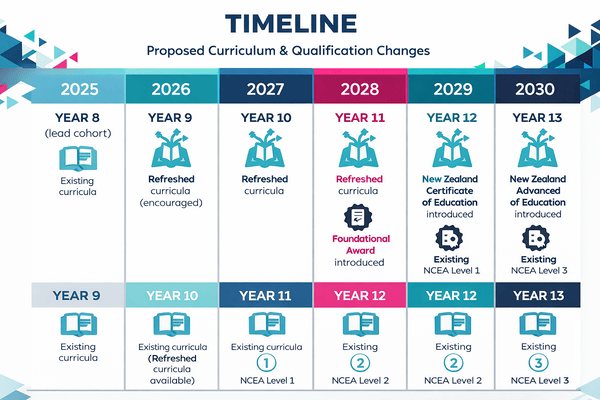
Worth noting: while the formal qualification changes don't hit senior students until 2028–2030, the curriculum shifts will be felt well before those dates. Planning, resourcing, and professional development will need to start now.
Why the Government Is Pushing This
The government's case for change centres on three concerns:
The current system is seen as too complex and inconsistent across schools. Literacy and numeracy outcomes, particularly at Year 11, need improvement. And a more structured framework, the argument goes, will produce more consistent results and clearer pathways for students.
The goal is a system that's easier for schools to navigate, more comparable across regions, and better aligned to post-school pathways.
Why Many Teachers Are Concerned
Those concerns don't exist in a vacuum. Alongside the policy rationale, many teachers and education groups have raised valid questions:
The pace and scale of change will create significant additional workload — at least in the short term. Schools may not have adequate time or resourcing to implement changes properly. And there are real questions about curriculum narrowing and reduced flexibility for teachers who've spent years crafting units that work for their students.
These aren't abstract complaints. They're grounded in the day-to-day reality of teaching: you're already managing a full classroom while being asked to overhaul how you plan, assess, and report.
The Real Tension
The government is focused on improving long-term outcomes. Teachers are focused on whether the system can actually handle the implementation.
Both concerns are legitimate. That's exactly what makes this period difficult to navigate.
What This Means In Practice
For most teachers, this won't feel like a policy shift — it'll feel like a workload spike in an already stretched year.
Practically, curriculum changes of this scale typically mean:
- Rewriting unit and lesson plans to align with new structures
- Learning new assessment frameworks and rubrics
- Updating marking schemes to reflect new criteria
- Maintaining consistency across your department or team while all of this is in motion
None of that is insurmountable. But none of it is small, either.
A Note On Getting Ahead Of It
The one thing that's certain in all of this: the work still needs to be done, whether the timeline shifts or holds.
The schools that will feel least disrupted are those that start aligning their resources early — not scrambling to catch up when the changes become compulsory.
That's where tools like Teacher's Buddy are designed to help. Teacher's Buddy ingests new curriculum content as it's published, so your planning and resourcing stays aligned to the current versions without the manual effort of starting from scratch.
Whether you're rewriting unit plans, updating rubrics, or "remixing" existing resources to fit new structures, the aim is the same: reduce the implementation burden so you can focus on your students.
If you'd like to see how it works, explore Teacher's Buddy here.
The Teacher's Buddy team is here to support you through this transition. We'll continue to update our resources as the government's curriculum rollout progresses.





.jpg)


.png)