
Teacher Burnout Is Not a Resilience Problem
Here's what the data says, and what schools can do about it.
When teachers say they're exhausted, anxious and unable to sleep, the conversation too often turns to better habits and self-care. That misses the point. Burnout is a structural problem — and the data is unambiguous about where it comes from.
Teacher burnout is not a resilience failure. It's what happens when a profession quietly expands its demands beyond what any reasonable person can sustainably carry.
When teachers admit that anxiety, sleeplessness and exhaustion have become their daily baseline, the response is often well-meaning — build better habits, set stronger boundaries, practise more self-care. The problem with that advice isn't that it's entirely wrong. It's that it locates the problem in the teacher rather than in the job.
The Data Is Unambiguous
In July 2025, researchers at UNSW Sydney found that nine out of ten Australian teachers were experiencing severe stress, and nearly 70% said their workload was unmanageable.
A few months later, the UK's Working Lives of Teachers and Leaders report found that 29% of teachers were considering leaving the state school sector within the next 12 months. Among those considering leaving, high workload and poor wellbeing were the most commonly cited reasons.
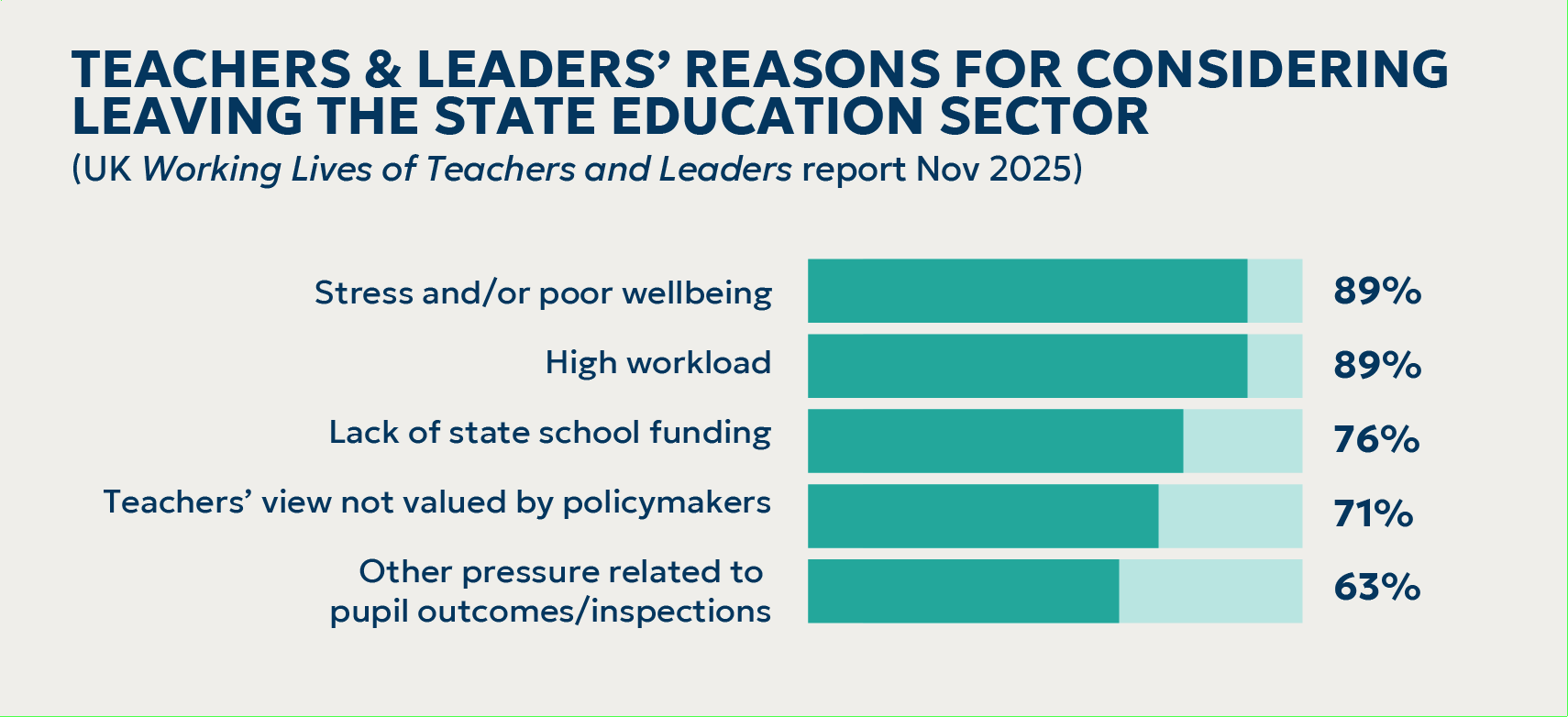
When the specific drivers of stress are examined, the picture becomes even sharper. Analysis of OECD TALIS data — spanning England, Australia, Canada, New Zealand and the United States — identified a clear hierarchy of stressors.
Marking is the biggest cause of stress
Across all countries studied, marking was the task most strongly associated with teacher stress. An extra hour of marking added nearly twice as much stress as an extra hour of lesson planning.
Lesson planning is the second biggest pressure point
In every country examined, more time spent preparing lessons was linked to lower wellbeing and greater workload pressure.
Classroom teaching itself is not the main driver
Once marking and planning were accounted for, an extra hour of classroom teaching had very little effect on overall stress levels.
The implication is uncomfortable: it's not how many classes teachers have that's wearing them down. It's the invisible labour that follows them home.
“In most education systems, teaching accounts for only about 43% of full-time teachers' self-reported total working time.”
— OECD Results from TALIS 2024, The State of Teaching
The Real Root Cause
Teaching has always been demanding. But somewhere along the way it became overloaded with tasks that sit around teaching rather than at the heart of it. Teachers entered the profession to have a positive impact on students' lives — but a growing number of additional responsibilities are pulling them away from doing exactly that.
Eight Things That Need Urgent Attention
Some aspects of modern teaching stand out as particularly unsustainable:
- Admin is swallowing teaching time. Documentation, uploading, logging and compliance tasks have expanded to a point where they're a significant drain on the day.
- Marking has become a second shift. When feedback consistently spills into evenings and weekends, it stops being part of the job and becomes an extension of it that teachers are expected to absorb silently.
- Planning has become too laborious. Adapting resources, differentiating for varying needs and building materials from scratch — week after week — is exhausting in ways that don't show up in any official workload measurement.
- Reporting creates intense workload spikes. Progress reports and formal updates rarely arrive during a calm week. They land on top of an already full plate.
- Fragmented systems create daily friction. Moving between multiple platforms to complete simple tasks may look minor from the outside. Repeated dozens of times a day, it becomes a real drain.
- Constant context-switching has a cost. Teachers move rapidly between teaching, behaviour management, pastoral care, planning, marking, admin and communication — often all before lunch.
- Low-value work is eclipsing high-value teaching. Not just that there is too much to do, but that too much of it feels disconnected from why teachers chose the profession.
- After-hours work has become the norm. For many teachers, the working day doesn't end when students leave — it continues at the kitchen table.
“Teachers are generally satisfied with their core teaching workload. It is the intrusion of paperwork, compliance frameworks, excessive data collection and non-essential professional development that leads to a sense of being overburdened.”
— Teachers' workload, turnover intentions, and mental health — ResearchGate 2024
The Resilience Conversation — Honestly
Of course resilience matters. Teaching is demanding work, and every teacher benefits from healthy ways to manage pressure. But resilience has limits. It cannot compensate for a job that has become structurally overloaded.
A teacher can have good habits, a supportive team, strong relationships — and still find themselves underwater. No amount of mindfulness can shrink a marking pile. No morning routine compensates for a reporting period that consumes three weekends.
At its worst, the resilience narrative becomes a polite way of asking teachers to adapt to conditions that should never have been normalised in the first place. Burnout, in that context, isn't a personal failing. It's a rational response to an unreasonable load.
What the Damage Actually Looks Like
When workload becomes excessive, the cost reaches further than exhaustion. A teacher running on empty has less energy for students, less creativity in the classroom, and a growing sense that the job is consuming their life. Over time, this leads to attrition — schools lose experienced, capable people not because those people stopped caring, but because caring alone stopped being enough.
The students in those classrooms feel it too. And schools that lose their most experienced staff don't just feel that loss in the short term — they carry it for years.
Practical Steps to Reducing Teacher Workload and Stress
There is a better future available to schools — not one where teachers are asked to keep absorbing more, but one where schools take a hard look at what is draining teacher time and redesign the job around what matters most.
- Audit the real workload — not just timetabled hours, but the total picture, including evenings and weekends.
- Strip back low-value admin. Review reporting, documentation and compliance with a sceptical eye. Not all of it serves students.
- Standardise what can be standardised. Shared templates and clearer workflows reduce the constant reinvention that drains planning time.
- Choose better tools. Technology should reduce friction, not add it. Fewer, better systems beat multiple fragmented platforms every time.
- Protect teacher judgement. AI and automation should handle repetitive tasks while leaving professional decisions in teachers' hands.
- Make workload part of leadership strategy. If schools are serious about retention, workload cannot be treated as a personal issue — it has to be treated as a design issue.
The Hopeful Future
None of this requires a complete system overhaul. It requires honest diagnosis and the willingness to act on what the data — and those in the classrooms — are already telling us.
Teachers are not burning out because they don't care. They're burning out because the job has quietly become too broad, too fragmented and too relentless for caring alone to sustain.
It's time the conversation caught up with that reality.




.jpg)



.png)